Overview
Our research investigates what happens to human cognition when life becomes increasingly abstract—mediated by screens, removed from nature, disconnected from immediate sensory experience.
We call this broader program Ecological Aliveness Theory: the study of how environments shape cognitive processing, and what conditions allow people to function with full range—not just analytical capacity, but presence, intuition, and flexibility.
We publish peer-reviewed academic work and translate findings into applied frameworks for individuals, organizations, and practitioners.
The Aliveness Model
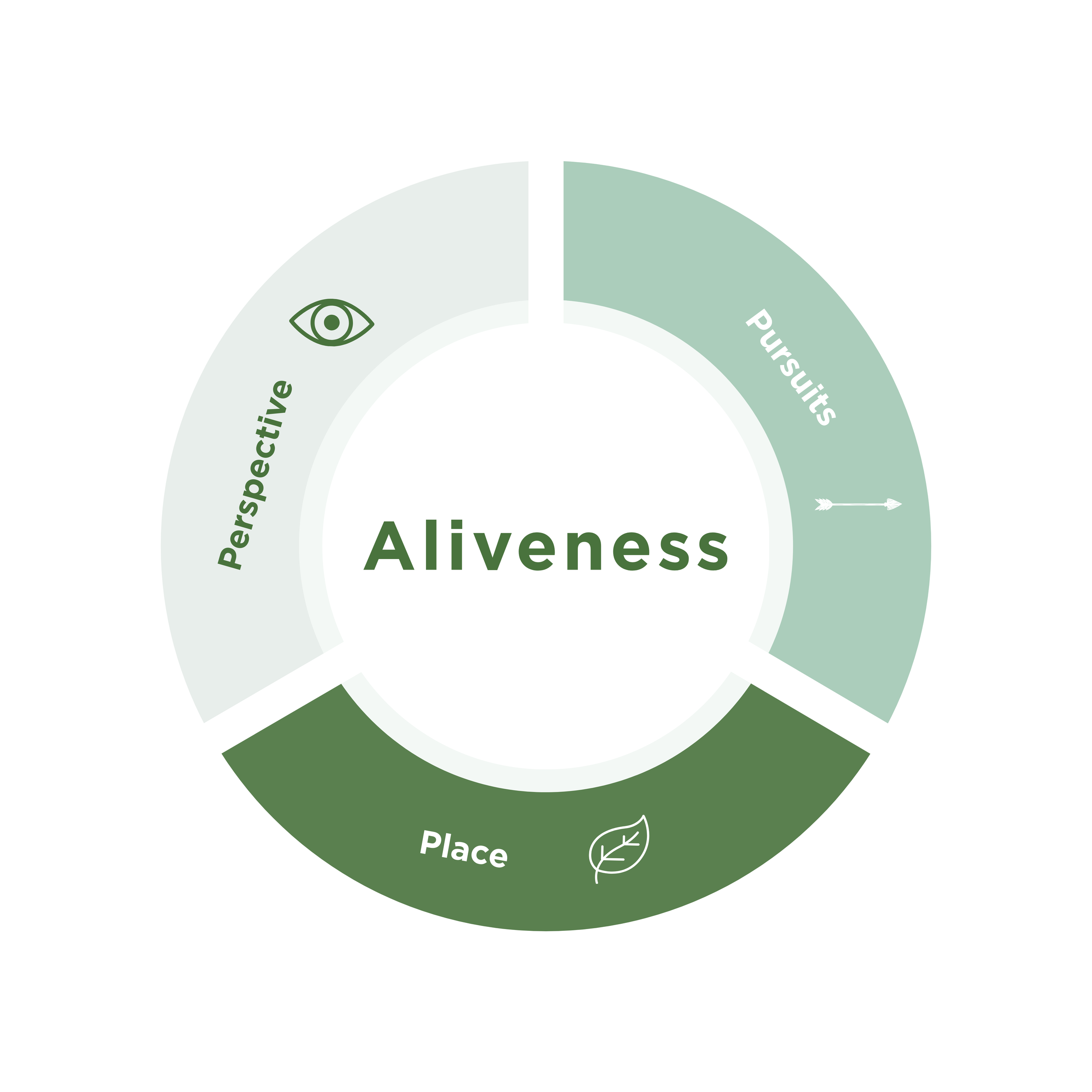
Our applied framework addresses three dimensions that modern knowledge work systematically neglects:
Place. Get grounded. What your physical environment affords. Sensory richness, nature contact, embodied presence. Knowledge work often occurs in sensory-deprived settings that reinforce abstraction.
Pursuits. Close the loop. How effort connects to tangible results. Feedback frequency, task closure, progress visibility. Knowledge work often leaves everything abstract and open-ended.
Perspective. Shift the culture. The organizational norms, values, and narratives that define what "good thinking" looks like. Knowledge work cultures typically recognize and reward only analytical cognition—treating concrete, relational, and intuitive modes as unsophisticated or irrelevant.
When all three dimensions are addressed, people regain cognitive flexibility—the capacity to shift between modes rather than being locked in constant analytical processing. This is the core capability that knowledge work erodes and that our interventions restore.
The Alive Papers
A monthly white paper series exploring cognitive flexibility and aliveness in the age of AI. Each paper examines how organizations can develop the uniquely human capabilities that matter most as artificial intelligence reshapes work.
Uniquely Human Skills for the Age of AI: Why Cognitive Flexibility Is the Foundation That Makes Them Possible
January, 2026. Every future-of-work report lists the skills that will matter most as AI reshapes organizations: creativity, critical thinking, emotional intelligence, adaptability, leadership, resilience. But why these skills? What do they actually have in common?
This white paper synthesizes research from cognitive science, neuroscience, and environmental psychology to reveal the answer: these capabilities all depend on cognitive flexibility—the capacity to shift between different modes of thinking based on what a situation requires.
More importantly, the research suggests that flexibility isn't primarily a skill to be trained. It's a natural capacity that emerges under certain conditions—and becomes constrained under others. Modern knowledge work often creates exactly those constraining conditions.
The implication for L&D: developing uniquely human capabilities may be less about adding new skills and more about restoring access to capacities people already have.
Ecological Aliveness Theory: Developing the Uniquely Human Capabilities for the Age of AI
January, 2026. Synthesizes the research into a framework for organizational intervention across three dimensions: Place (physical environment), Pursuits (work structure and feedback), and Perspective (cultural norms around cognition). Provides a roadmap for shifting from behavior change to system change—creating conditions that restore cognitive flexibility rather than training individuals while leaving suppressive environments intact.
What We Left on the Ground: The Environmental Factors That Shape Cognitive Flexibility—And What Organizations Can Do About Them
December, 2025. Presents research identifying four environmental factors that support cognitive flexibility: immediate feedback, experiential learning, natural environments, and cultural norms that value interconnection. These factors were ubiquitous in immediate-return environments humans evolved in but are systematically absent from modern knowledge work—suggesting that environment may matter more than individual training in restoring access to concrete cognition.
The Ladder of Abstraction: How 10,000 Years of Technological Progress Shaped Human Cognition—And Why It Matters Now
November, 2025. Traces how four technological revolutions—agricultural, industrial, digital, and intelligence—have progressively pulled human cognition into abstraction, producing "abstraction habituation": a narrowing of cognitive range that leaves knowledge workers stuck in analytical mode. The uniquely human capabilities organizations need most (creativity, intuition, emotional intelligence) live in concrete cognition, which modern work systematically suppresses.
Published Research
The Abstraction Habituation Model of Knowledge Worker Burnout (Frontiers in Psychology, 2025)
This paper proposes that sustained abstract work progressively erodes the cognitive flexibility needed for psychological recovery and adaptive functioning. It's not that knowledge workers are stressed—it's that they've been trained into a single cognitive mode and lost access to others.
The model explains why rest doesn't restore, why vacations don't help, and why wellness programs targeting stress miss the actual problem.
Framing the Mind: Media, Metaphors, and Mindfulness (Frontiers in Social Psychology, 2025)
This paper examines how cultural narratives and media environments shape our relationship to our own minds—and why certain metaphors make mindfulness more or less accessible.
The Environmental Model of Mindfulness (Frontiers in Social Psychology, 2024)
This paper challenges the assumption that mindfulness requires formal meditation. Drawing on cognitive science, anthropology, and social psychology, it identifies four environmental factors that naturally cultivate mindful states:
Immediate feedback from the environment
Observational learning opportunities
Exposure to natural settings
Interconnected self-construal
The model explains why certain activities—working with horses, spending time in nature, engaging in craft—create presence without requiring meditation training. It has direct implications for workplace design, leadership development, and experiential practice.
Workplace Mindfulness Through Role Clarity: Extending the Environmental Model (SIOP Conference, 2024)
This study extends the Environmental Model of Mindfulness into workplace settings, examining how organizational structure shapes present-moment awareness. Using Structural Equation Modeling with 170 full-time employees, it finds that:
Role clarity significantly predicts trait mindfulness (β = .44)
This effect holds even after controlling for prior mindfulness practice experience (β = .19)
Clear goals and expectations create conditions similar to immediate-return environments
The model positions Industrial/Organizational psychology at the forefront of mindfulness research, demonstrating that workplace design—not just individual meditation practice—can foster mindfulness across an organization.
Cultivating a Mindful Workforce: Is Mindfulness Training Enough? (SIOP Conference, 2020)
This paper questions whether mindfulness training programs alone are sufficient for organizations seeking to cultivate mindful employees. Drawing on data from 854 full-time workers, it examines the relative importance of three antecedents of trait mindfulness:
Individual differences (emotional stability, conscientiousness, personal mastery, motivation-related anxiety)
Work context factors (clarity, team trust, autonomy, workload, cognitive demands)
Mindfulness training interventions
The findings reveal that individual differences are the strongest predictor of employee mindfulness (R = .56), followed by mindfulness training (r = .40) and work context (R = .39). The study suggests that organizations aiming to cultivate mindfulness should look beyond training programs to consider hiring practices and workplace design.